
Dirga Raj Lama
Web Developer
Laravel vs Node.js: Complete Comparison for Beginners (2026 Guide)
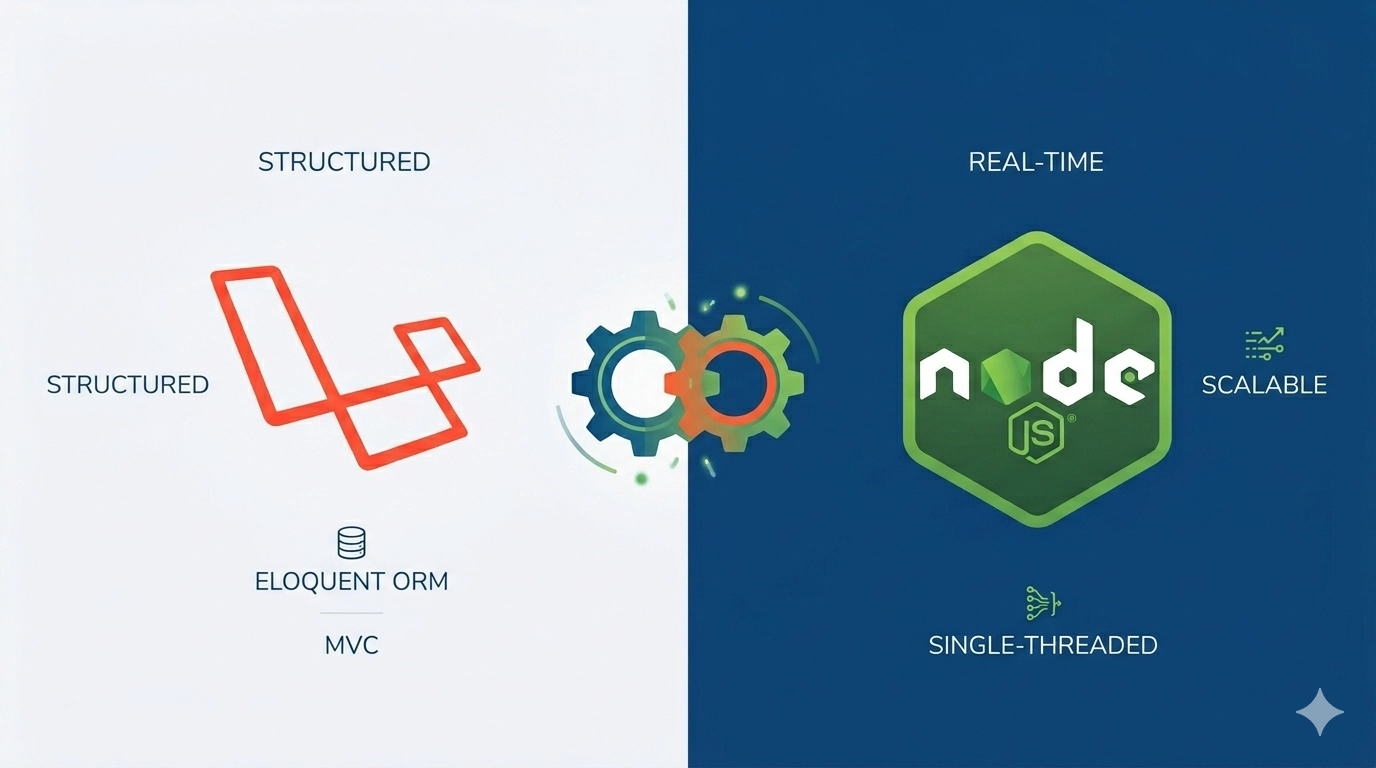
If you are stepping into the world of web development in 2026, you have likely encountered a massive roadblock: Should I learn Laravel or Node.js?
Both are powerhouse technologies used by giants like Tesla (Laravel) and Netflix (Node.js). However, they serve different purposes and cater to different types of developers.
In this Laravel vs Node.js: Complete Comparison, we will strip away the jargon and look at these two platforms through the eyes of a beginner. By the end of this guide, you will know exactly which one aligns with your career goals and the type of projects you want to build.
What is Laravel?
Laravel is a PHP-based backend framework. It has been the king of PHP frameworks for nearly a decade. Laravel follows the “MVC” (Model-View-Controller) pattern and is famous for its elegant syntax and “batteries-included” philosophy.
When you choose Laravel, you get a structured, opinionated way of building web applications. It comes with built-in tools for authentication, routing, caching, and database management (Eloquent ORM) right out of the box.
What is Node.js?
Technically, Node.js is not a language or a framework; it is a runtime environment that allows you to run JavaScript on the server.
While Laravel is a specific framework, Node.js is the environment that hosts various frameworks like Express.js, NestJS, or AdonisJS. When people say “I’m learning Node.js,” they usually mean they are learning to build backends using JavaScript.
The Core Differences
To make this Laravel vs Node.js: Complete Comparison useful, let’s break down the key factors that matter to a beginner in 2026.
1. Language & Learning Curve
- Laravel (PHP): If you are building a traditional website (like an e-commerce store, a CRM, or a blog), Laravel is unmatched in speed of development. PHP is a synchronous language, meaning it handles tasks one at a time. Laravel’s documentation is considered the gold standard in the industry. If you want structure and predictability, Laravel is easier to start with.
-
Node.js (JavaScript): Node.js uses JavaScript. If you already know frontend frameworks like React or Vue, Node.js allows you to use the same language for the backend. However, Node.js is asynchronous and event-driven. Beginners often struggle with “callback hell” (though modern Promises and Async/Await have fixed this) and managing the chaos of npm packages.
Verdict: Laravel is easier for beginners who want structure. Node.js is easier for frontend developers wanting to transition to full-stack.
2. Performance
- Laravel: Being PHP, each request usually loads the entire framework from scratch. While tools like Octane (Swoole) have massively improved performance in recent years, traditionally, Laravel is slower in raw API requests compared to Node.js.
-
Node.js: Node.js shines here. Because it uses the V8 engine and non-blocking I/O, it handles thousands of concurrent connections with less memory usage. If you are building a real-time application (like a chat app or a streaming service), Node.js is the clear winner.
Verdict: Node.js wins for high-performance, real-time apps. Laravel is fast enough for 95% of standard business applications.
3. Ecosystem & Development Speed
This is where Laravel takes the crown.
- Laravel: It is “batteries-included.” Need user authentication?
php artisan make:auth. Need a admin panel? Use Nova or Filament. Need to handle queues? It’s built-in. In 2026, Laravel offers Livewire (for dynamic interfaces without writing JavaScript) and Volt (functional components), allowing solo developers to build full-stack apps incredibly fast. -
Node.js: Node.js is “micro-framework” oriented. You start with Express, but you have to manually stitch together libraries for security, authentication (Passport.js), database connection, and validation. This offers flexibility but drastically slows down initial development for beginners.
Verdict: Laravel wins for rapid application development (RAD).
4. Job Market & Future Trends (2026 Outlook)
- Laravel: Laravel powers a massive portion of the “SaaS” (Software as a Service) industry. In 2026, there is a high demand for Laravel developers in agencies, startups building MVPs, and enterprise corporations looking to maintain legacy PHP systems. The salary is competitive, but the market is slightly more saturated than niche JavaScript roles.
-
Node.js: Node.js developers are in extremely high demand, especially in tech hubs and for companies building microservices, APIs for mobile apps, and serverless architectures. Because Node.js is often paired with React or Vue, “Full Stack JavaScript” developers command some of the highest salaries in the industry right now.
Verdict: Node.js generally offers higher salary ceilings, but Laravel offers stable, long-term employment with less “framework fatigue” (JavaScript changes rapidly, PHP/Laravel changes slowly and steadily).

When to Choose Laravel
You should choose Laravel if:
- You are building a traditional web application (SaaS, e-commerce, internal tools).
- You want to build an MVP (Minimum Viable Product) in a matter of days, not weeks.
- You prefer having a single, official documentation to follow for everything.
- You want to use tools like Filament or Livewire to build admin panels without writing React/Vue code.
When to Choose Node.js
You should choose Node.js if:
- You are building a real-time application (chat, gaming, collaborative tools).
- You are building a REST API or GraphQL API that needs to handle thousands of concurrent users.
- You are a frontend developer (React/Angular/Vue) who wants to stay in JavaScript for the full stack.
-
You want to work heavily with microservices or serverless architecture (AWS Lambda).
The Verdict: Which One Should a Beginner Learn in 2026?
If you are a beginner with no programming experience, the Laravel vs Node.js: Complete Comparison points to one conclusion based on your goals:
Choose Laravel if: You want to build websites and web applications quickly and get hired by agencies or mid-sized companies. The structured nature of Laravel teaches you good coding habits (MVC, OOP) without overwhelming you with configuration choices.
Choose Node.js if: You are already learning JavaScript for the frontend, or you are specifically interested in high-performance APIs, real-time data, and modern tech startups. Be prepared to spend a lot of time learning which packages to use together.
Conclusion
There is no “right” answer to Laravel vs Node.js: Complete Comparison—there is only the right answer for your project and your career.
In 2026, both ecosystems are thriving. Laravel continues to dominate the PHP space with incredible DX (Developer Experience), while Node.js remains the backbone of the JavaScript ecosystem.
Advice: Learn both eventually. Start with one, build a project, and then explore the other. A great developer isn’t defined by their language choice, but by their ability to pick the right tool for the job.